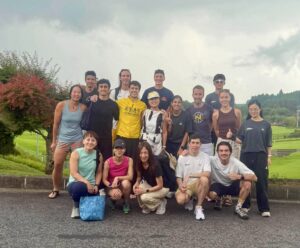
May 27th, 2026 — 5km Time Trial
June 5, 2026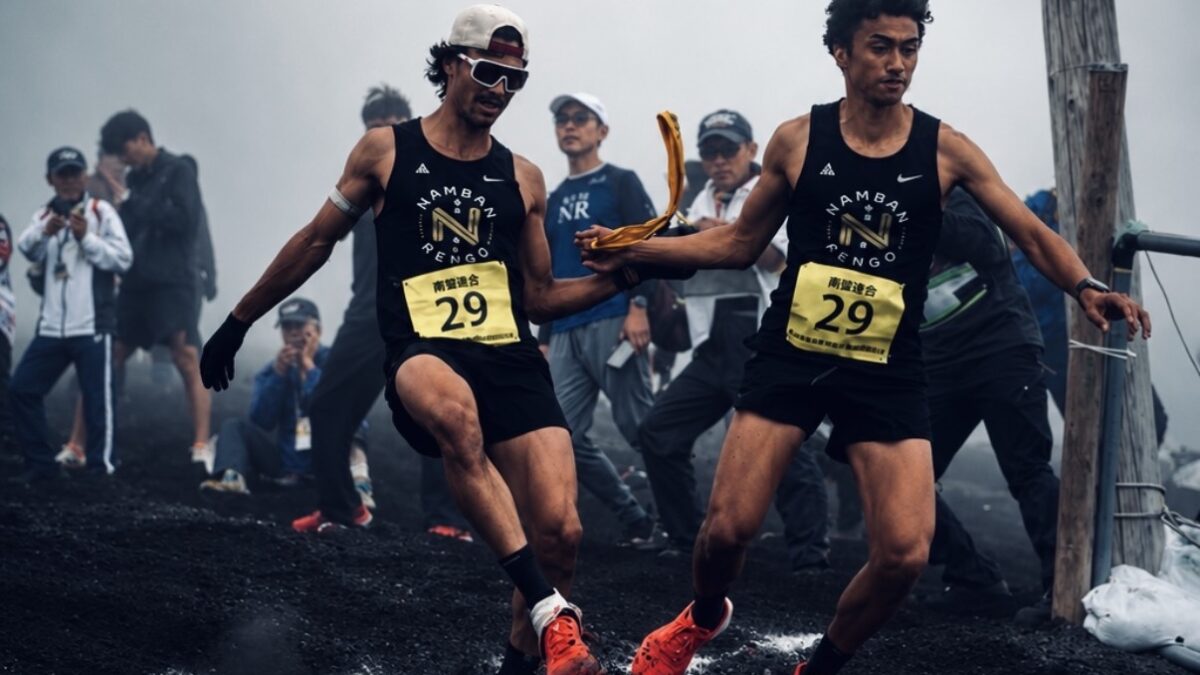
Team Member Selection – Harrisson – Confidence
Team member selection is always tricky and difficult.
Around March, I received the invitation from the organizers to take part in this Ekiden, which meant it was time to start thinking about the team selection. Having participated in the race three consecutive times, this year I decided to step aside, yield my runner’s seat, and be a substitute and the team’s coach.
From my experience, I have gained a better sense of the physical demands of the race and the kind of runners to look for. For me, selecting members should not only be about physical ability. There also needs to be team spirit and a sense of cohesion. For that reason, I would favor runners who are already friends rather than total strangers, as I believe team bonding is an important part of the equation.
Even though nobody is competing for the Olympics and the event is ultimately just for fun, everyone on the team takes it extremely seriously. Since this race is mostly by invitation and we can only send one team to represent the club, each of us can’t help but feel immense pressure to perform.
Road Runner Selection
This year again, Corey and Graham came to mind immediately. They are both running sub-75 min for a HM / low-16 min for a 5k, without major setbacks and with relatively consistent training all year long.
Cal has been breaking his PBs for the past two years and has been in fantastic shape.
The three of them know each other well and are good friends.
Although you cannot “win” the race on the road, you can compromise it very easily. It’s a bit like the swimming part of a triathlon.
Trail Runner Selection
Legs 4 and 8 need a runner with strong climbing ability, usually someone with a high VO₂max / a fast 10k runner. As Leg 8 (downhill) isn’t extremely steep except for the first 500m, it is more forgiving in terms of descending ability.
Sabri naturally came to mind. He recently ran a 2:32 marathon and is also strong over shorter distances. He averages 2:55–3:05 for 1000m during our Wednesday sessions.
Legs 5 and 7 are the most crucial. They are the hardest and take the longest time to complete. They require someone who is not only very strong at climbing and at high altitude, but also very strong going downhill during the “Grand Sand Run – 大砂走” of Leg 7. That section is not particularly technical but requires the ability to run at a vertical speed above 6000m/h, or faster than a 3:20 min/km pace.
Ewan had recently run a 2:35 marathon and 15:50 for 5km. He is also a very fast descender and, as a triathlete, has a very consistent training schedule all year long.
Leg 6 is the trickiest and most difficult when it comes to athlete selection. Because the downhill part is very technical, it requires someone with good climbing ability—not necessarily top-notch—and excellent technical descending skills, while also being able to run at altitude. A runner with a very high VO₂max but poor descending skills is a no-go.
Hanah is not the strongest climber in the club; she has decent/respectable ascending speed. But her descending skills on technical terrain are excellent, to say the least.
Moreover, if we made it before the kuriage cutoff, we would probably be the only mixed team to achieve that, which is, quite frankly, badass.
Last but not least, I was confident that each one of them would take the task and responsibility very seriously and would train properly for it.
Let’s just say I was not disappointed, to say the least!!
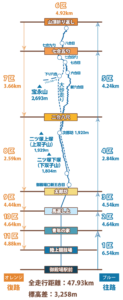
Target Time Assignment
As the team coach, I am aware of the pressure that comes with assigning a target time to a runner. So I always try my best to assign a realistic and attainable goal.
Cal — Target rating: Slightly optimistic
I assigned him the same time as last year’s runner, Sean. Cal had run 16:50 at a parkrun “without trying,” so he was potentially in 16:30 5k shape, which was Sean’s shape last year.
Graham — Target rating: Fair / Realistic
Corey — Target rating: Slightly optimistic
Both Corey and Graham were assigned the same target times as last year. I was confident about Graham, but I was a bit concerned about Corey, as his splits on the track were a bit slower compared to last year, and he confirmed that he wasn’t feeling in great shape either.
Sabri — Uphill target rating: Conservative
Sabri — Downhill target rating: Realistic
I’ve found that Leg 4 performance is highly correlated with the athlete’s 10k road race time.
I estimated that he could run at least sub-33 min for 10k, but since he had never raced on that type of terrain, I kept his target time at 33:30.
On the downhill, having personally run 8:20, I was confident he could beat that and also go under 8 minutes.
Ewan — Uphill target rating: Conservative
Ewan — Downhill target rating: Realistic
Leg 5 is probably the toughest of the race. Our course record, held by Tom in 2024, was 54:52. Ewan, on one hand, is significantly faster than Tom on the road and is also an accomplished cyclist. Tom, on the other hand, is an extraordinary climber. So I estimated that Ewan could run under 56 minutes without much issue.
On the 3km downhill Leg 7, I originally set a target of 10:30, thinking it could be a bit optimistic/aggressive, having never seen him run downhill. Our course record, also held by Tom, is 8:50. The only information I had was that Ewan loved descending.
On a team reconnaissance run, I saw him flying downhill at a sub-2:40 min/km pace—faster than 8000m/h of vertical speed.
Then I changed the target time to a realistic sub-10 minutes.
Hanah — Uphill target rating: Realistic
Hanah — Downhill target rating: Realistic
I estimated that Hanah should be able to run 59 minutes for Leg 6: 42 minutes on the climb and 17 minutes on the descent.
Our course record on the ascent was held by Derder in 40 minutes, who at the time was around an 18:20 5k runner.
Hanah’s 5k PB was around 20–30 seconds slower than Derder’s, so it seemed realistic to set the target at 42 minutes.
On the descent, Derder’s time—also our course record—was 14 minutes. Having run with both of them personally on numerous occasions, I knew Derder’s ability on technical descents was on another level.
Hanah is very strong on technical downhill, but there was still a gap. So I estimated that she could run 17 minutes.
Once I shared the target times with everyone, all six of them took their task extremely seriously, and I was quite impressed by their dedication.
I was confident we could come back with the yellow Tasuki this year.
| Runner | Target | Cumulative Estimate (min) | |
| Leg 1 – Uphill | Cal | 23 | 23 |
| Leg 2 – Uphill | Graham | 24 | 47 |
| Leg 3 – Uphill | Corey | 23 | 70 |
| Leg 4 – Uphill | Sabri | 33.5 | 103.5 |
| Leg 5 – Uphill | Ewan | 56 | 159.5 |
| Leg 6 – Uphill | Hanah | 42 | 201.5 |
| Leg 6 – Downhill | Hanah | 17 | 218.5 |
| Leg 7 – Downhill | Ewan | 10 | 228.5 |
| Leg 8 – Downhill | Sabri | 8 | 236.5 (cutoff = 240min) |
| Leg 9 – Downhill | Corey | 13 | 249.5 |
| Leg 10 – Downhill | Graham | 13.5 | 263 |
| Leg 11 – Downhill | Cal | 17.5 | 280.5 |
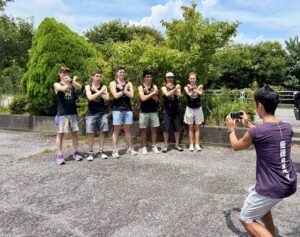
Leg 1 – Cal – Wrecked
Firstly, huge thanks to our supporters and the Otaku (Harrisson) for organizing. We had such a wonderful crew covering all legs of the race. Everything was well organised, and it made a big difference.
Secondly, YESSSSSSSSSSSS! We did it! Proud to be part of such a strong team — the first mixed gender team for Namban in this event — and to finish with the yellow tasuki after we didn’t in 2025. I have so much respect for these runners and the effort they put in. We looked at the tasuki after, and all the sweat had nearly washed away the stamp from the summit.
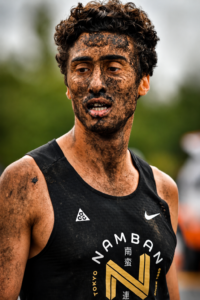
Thirdly, I cannot get over those images of Sabri’s face covered in dust, looking a little confused but also excited like somehow he dived headfirst into a chocolate cake. Love it!!
The Race
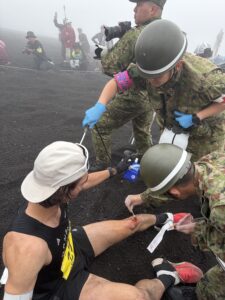
Gah. I tried my best, but it wasn’t my best. I was in pretty good shape after a recent 5K PB, and while I thought Harrisson’s estimate was rather optimistic, I was pleased he had faith in me to tackle this section. However, I didn’t have the stamina for it on the day. In the heat, that hill is relentless, and I ran out of energy halfway. I didn’t think I’d need to carry a gel in a 6km race lasting 25min, but in this instance it could have helped prevent the dizziness I felt towards the end. Nonetheless, I pushed on — trying not to be bothered by the TV cameras following my struggle — stumbled to Graham at the checkpoint and collapsed.
My partner Yumié said she’s never seen me like that after a race.
I was wrecked. It took about 10-15min to regain composure and get my breathing under control. After the disappointment of 2025, I was really hoping we had enough time to beat the cutoff, but still confident in the team to pull us through. So I did my best to rehydrate, rest, and refuel as cleanly as possible to be ready for the final leg.
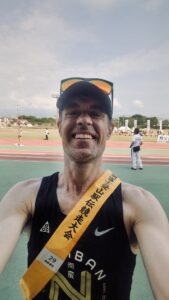
Leg 2 – Graham – 満足
I was determined to give it my all on the uphill since our estimated times put us only 2 minutes ahead of the kuriage start. It felt longer than the 23:44 I ran due to the steep hill, but I was happy I beat my time from last year!
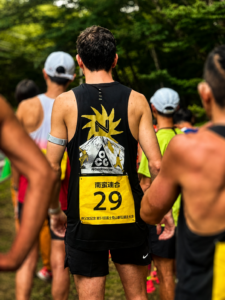
Leg 3 – Corey – Crawling
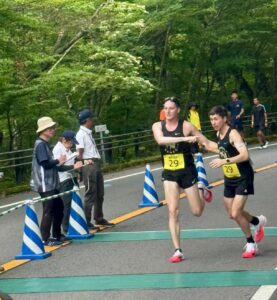
Leg 4 – Sabri – Brain switched off
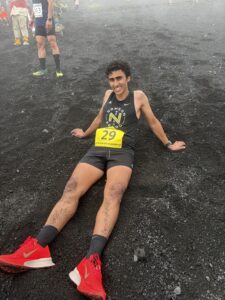
Leg 5 – Ewan – In The Zone
I’m usually OK with climbing, and I love descending. But I had an issue as my main goal for 4 months was a triathlon with a super flat running leg. It left me with 4 weeks to build up climbing skills. Harri added to my homework some reading about previous Namban participation in the race. It became obvious that it was also mandatory to recon the specific racing conditions: Gotemba trail’s sand is a bad b***h.
In 4 weeks I managed around 13k elevation, including 2 key sessions on Mt Fuji.
Ekiden leaves you so much pressure on race day.
Even though you feel fresh and trust that the job is done, the fact that the team and the crew are putting so much effort themselves and rely on you for your part of the job is creating a crazy mix of nervousness and excitement.
So, of course, when Sabri surged his leg and handed me the Tatsuki, I took off way too fast.
I was saved by chats with Cal and race recaps (Tom: “With one of my long strides for every two of the runners ahead”).
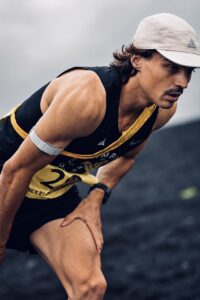
From then on, I stayed in my zone and kept pushing my feet in the sand. I received so much support along the way: ACG members first and then Aurel. I’m afraid I didn’t pay them back even with just a look… I owe you!
Closing to the end, I had to dig deep to keep up the pace and run in flatter sections. I didn’t know exactly where the relay station was… I felt so relieved when I saw the last ramp, on top of which Hanah would deliver me from the burden of that Tasuki. She took off fast, and I figured out she wasn’t gonna leave me much time to rest before leg 8…
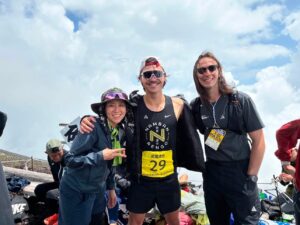
Leg 6 – Hanah – 全集中
“59 minutes”
This was the target time Harrisson had given me for my leg.
This is to run 2.5 km uphill starting at 3100m all the way to 3700m, get the tasuki stamped at the summit shrine, turn around, and charge back down.
That number haunted me for weeks leading up to race day. I knew any slip-up could cost us the tasuki deadline, and I’d be letting down the entire team.
I have summited Mt. Fuji via the Gotemba route several times a year since moving to Japan four years ago, so I knew the course fairly well. But I had no idea what this “59 minutes” meant, apart from the fact that it sounded pretty ambitious. I decided I needed to recce the route. I went once to get used to the high altitude (the first Fuji of the year is never easy!) and a second time to run a time trial. It turns out it’s very difficult to replicate race day conditions when it takes hours of climbing just to reach the start of your leg. During my test run, it took me about an hour just to finish the uphill section. That certainly didn’t do much for my confidence!
Fast forward to race day. I was tracking live updates in the Namban group chat, seeing everyone hit their target times and keeping us on track. As my estimated start time approached, I started getting ready. Suddenly, I heard a race official yell out:
“No.29! NAMBAN RENGO!”
Ewan was running waaay ahead of schedule and reaching the transition zone much earlier than expected. I threw everything I was holding onto the ground and sprinted to the start line.
Then I saw him. HOLY!! HE REALLY IS HERE!!!!!! The excitement instantly kicked in.
Ewan handed off the tasuki, and I will never forget that exact moment.
The sash was so soaked with everyone’s sweat that I probably could have wrung water out of it. It made the emotional weight of the team I was carrying feel so real. Hanah, do not screw this up!
I stuck strictly to my strategy – power hike the steep ascents and run the few flat sections (mostly in front of mountain huts and near the summit). As I neared the peak, the strategy paid off. I passed two runners who had burned themselves out.
Reaching the summit, I ran the final flat stretch to the shrine and got the tasuki stamped. My heart was pounding out of my chest – there is 30% less oxygen up there compared to sea level.
I turned around and began the descent.
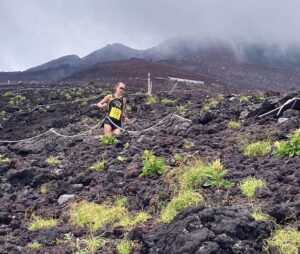
That’s where I hit a bump. With my heart pounding and my head feeling light, I had to slow down to catch my breath. I got overtaken by a few guys (they were nuts, FLYING downhill at breakneck speed!) Once I felt slightly better and tried to kick back into gear, I twisted my ankle, which set me back again. I was frustrated, but I focused on descending. After all, my sole mission was to get back down and pass the tasuki back to Ewan.
Fortunately, the weather was on my side. With clear visibility, I could see the handoff zone getting closer and closer. I carved around the last turn, spotted Ewan waiting, and handed off the sash.
I looked down at my watch.
“58 minutes”
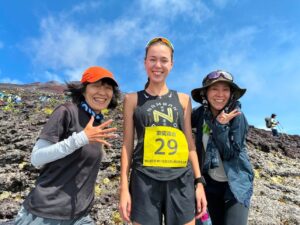
p.s – special thanks to Rie, Yuki and Aurelien who helped support me in my leg!
Leg 7 – Ewan – Diving
I had done 2 proper recons of the descent and had even managed an interval with 2’27/km and -9000m/h, which is only possible thanks to Fuji-san’s sand. At that speed it’s difficult to bring back the legs fast enough to the front; that’s why falls are usually face-first…I had “practiced” face planting as well. It allowed me to realise it wasn’t that bad.
I was confident and ready to push it.
After a refuel powered by Namban crew, it was time to go again.
As I reached the soft sand section, I dived into a deep fog… this, together with the speed and the muscles’ fatigue, made me dive, but in the sand this time… I picked up my stuff, took off again, only to crash a minute later! Fortunately, soon after I could see Sabri appear through that fog.
So maybe the key to a good descent is to practice falling! (I cannot be liable for any accident following this advice, please). Better advice would be to recommend Ekiden races; they’re a super experience, bringing Namban members together.
PS: I clocked a good time, but still 40 seconds (7%) behind Tom’s 8th leg record. I guess he’s a bird.
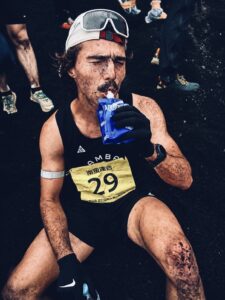
Leg 8 – Sabri – Ash in my eyes
.
Leg 9 – Corey – Grateful
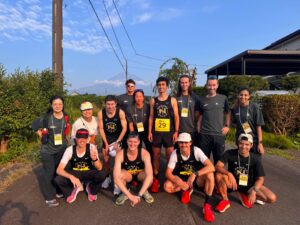
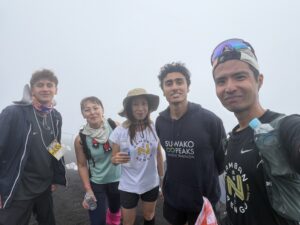
Before the start
Leg 10 – Graham – Negative split
Being with supporters during the >3hr wait between legs helped me relax instead of nervously checking our team’s results every 5 minutes. And once we saw how well the team was doing, I felt motivated to compete for places.
Unfortunately, I got passed by 1 general qualification runner, but I was happy that I ran a negative split even though the second half was a bit slower and much hotter. It was a very fun weekend spent with Namban members, and big thanks to Nike ACG for the partnership!
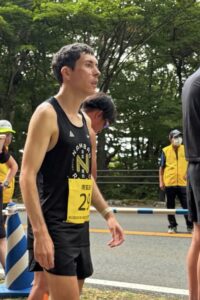
Leg 11 – Cal – Final Surge
Weeeeeeeeeee. That was more fun. Knowing we had the yellow Tasuki, I was free to run more comfortably. Every step felt like a reward for the pain going uphill.
Of course it wasn’t — this leg is still tough. After 2 km, the midday heat kicks in, the throat starts to burn, and I was wondering “when is this hill going to end?” Then it does, and you’re hit with a punishing uphill section just before the stadium. When I finally arrived, I was happy to finish with a strong Final Surge, meet my target time, and cross the line for the team with the coveted yellow tasuki proudly embracing my Namban shirt.
Learnings
Having run legs 1 and 5 now, I can say that no matter which leg you do, this race is incredibly demanding. And it demands specific preparation. You can be fit, you can be fast, but unless you are Yuta-san, it almost certainly helps to spend a significant amount of time training on the mountain, in the hills, in the heat, or whatever it takes to be ready for Fuji-san, including fueling and nutrition as Ewan did. His performance was phenomenal. Massive congrats also to Graham, Corey, Sabri and Hanah for outstanding runs. On reflection, I am genuinely humbled to be in the same league as you.
Result Summary
(Rotate your screen if reading from your smartphone)
Legs 1 to 5: uphill, Leg 6: uphill and downhill (summit), Legs 7 to 11: downhill
Number of teams in the general category: 78
Number of teams to pass the Kuriage (繰り上げ) cutoff: 26
| Target | Cumulative Estimate | Actual | Cumulative actual | Team Rank | Individual rank | ||
| Leg 1 – 6.2k | Cal | 23:00 | 23:00 | 25:07 | 25:07 | 43 | 43 |
| Leg 2 – 4.6k | Graham | 24:00 | 47:00 | 23:44 | 48:51 | 43 | 44 |
| Leg 3 – 4.5k | Corey | 23:00 | 1:10:00 | 24:09 | 1:13:00 | 37 | 25 |
| Leg 4 – 2.9k | Sabri | 33:30 | 1:43:30 | 32:31 | 1:45:31 | 29 | 23 |
| Leg 5 – 4.2k | Ewan | 56:00 | 2:39:30 | 52:22 | 2:37:53 | 19 | 10 |
| Leg 6 – 2.5k | Hanah | 42:00 | 3:21:30 | 39:30 | |||
| Leg 6 – 2.5k | Hanah | 17:00 | 3:38:30 | 18:40 | 3:36:03 | 23 | 44 |
| Leg 7 – 2.9k | Ewan | 10:00 | 3:48:30 | 09:28 | 3:45:31 | 22 | 7 |
| Leg 8 – 2.7k | Sabri | 8:00 | 3:56:30 | 07:49 | 3:53:20 | 22 | 17 |
| Leg 9 – 4.4k | Corey | 13:00 | 4:09:30 | 12:53 | 4:06:13 | 21 | 12 |
| Leg 10 – 4.6k | Graham | 13:30 | 4:23:00 | 13:42 | 4:19:55 | 22 | 29 |
| Leg 11 – 5.5k | Cal | 17:30 | 4:40:30 | 17:48 | 4:37:43 | 22 | 40 |
From the runner to the support team: Big “Thank You”
In alphabetical order:
- Alaric (Ewan’s little brother)
- Alexis
- Aurelien
- Ayumi
- Meghna
- Stephanie
- Rie
- Taeko
- Weifang
- Yoko
- Yumie
- Yukiko
Last but not least:
ACG Tokyo for the partnership with Namban Rengo and providing us with amazing support!!